


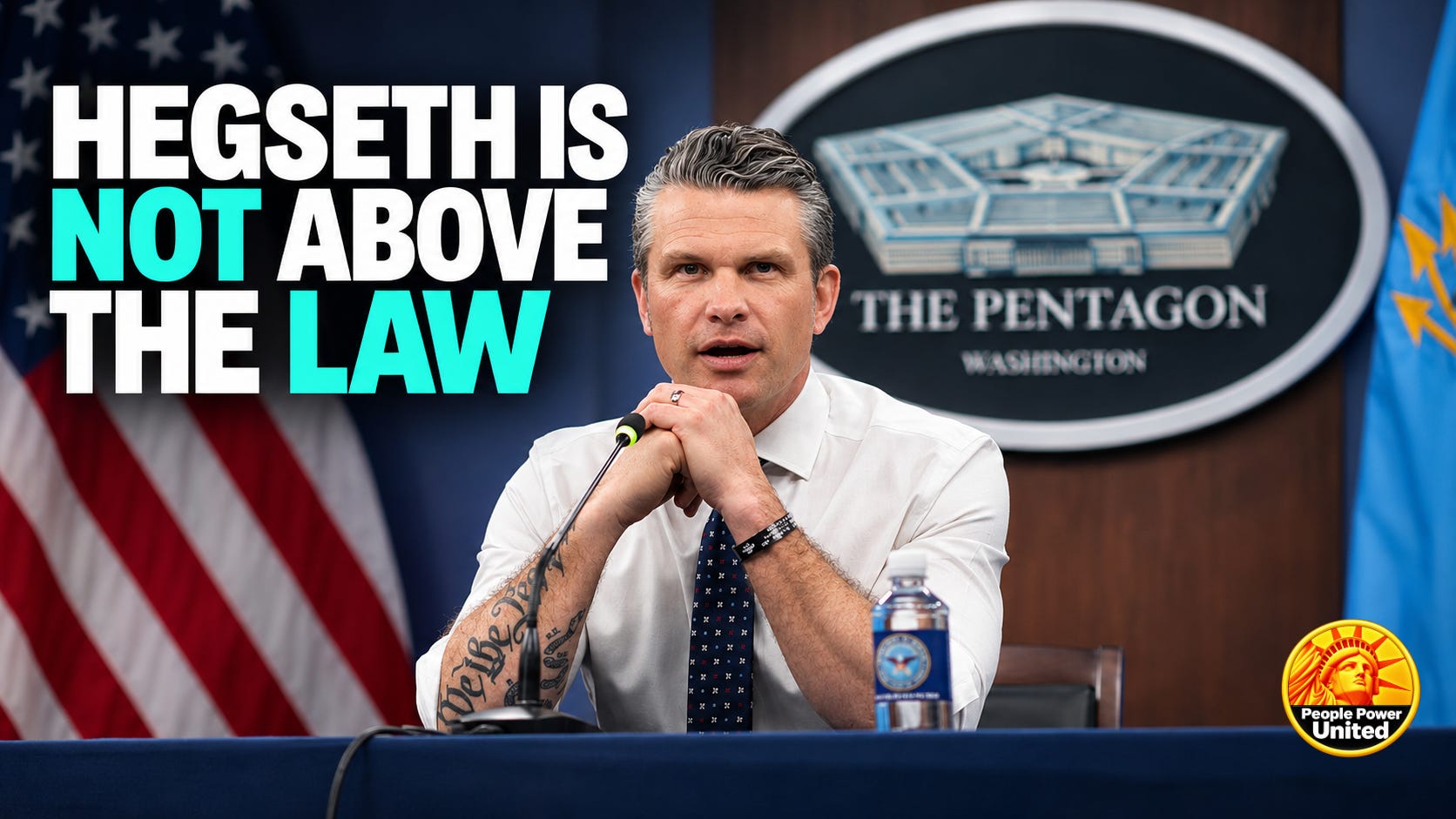
Pete Hegseth, Impeachment, and the Pentagon’s Accountability Problem
Friends, apparently launching a war without congressional authorization, dismantling civilian protections, mishandling sensitive military information, and trying to punish a sitting senator for speaking out are not enough to get you fired in Washington.
But heaven forbid an ordinary American forget to pay a parking ticket.
Welcome to the latest episode of Accountability for Thee, but Apparently Not for Me, starring Defense Secretary Pete Hegseth.
And buckle up, because this one is a doozy.
Since February 28, 2026, the United States has been at war with Iran. Congress never voted to authorize that war. American military strikes have killed people aboard suspected drug-trafficking boats. Hegseth’s attempt to punish Senator Mark Kelly had to be blocked a federal judge. And the Pentagon’s own Inspector General documented serious problems with Hegseth’s handling of sensitive military information.
Now, with impeachment efforts gaining attention following the midterm elections, the man running the Pentagon has some explaining to do.
And by explaining, I mean under oath, with documents, witnesses, and actual consequences. Not another television appearance where everyone pretends the Constitution is merely a suggestion.
To be clear, impeachment articles contain allegations, not convictions. A preliminary court order is not a final judgment. And an international human rights expert’s assessment is not a criminal verdict.
Those distinctions matter.
But so does the growing body of evidence demanding answers to serious questions.
And friends, we have some serious questions.
🚨 A War Without Congress. Because Apparently That’s Optional Now?
Let’s start with something you probably learned in school.
Congress has the constitutional power to declare war.
Not the Secretary of Defense. Not the president acting as though Congress is an inconvenient group chat. Congress.
Our founders divided war powers for a reason. They understood that allowing one person to make enormous military decisions without meaningful checks is a dangerous proposition.
Yet the United States began military operations against Iran on February 28 without a new congressional authorization for that war.
Republican Representative Thomas Massie has challenged that decision and pursued impeachment proceedings against Hegseth. His resolution raises serious questions about executive authority, congressional oversight, and the human consequences of military action. 1 2
And here’s where things become especially ridiculous.
Congress can spend days arguing about who said what on television. But when it comes to exercising its constitutional authority over war, everyone suddenly develops a mysterious case of legislative paralysis.
Friends, the Constitution is not a decorative document.
It’s not something politicians can pull out for campaign speeches and shove back into a drawer whenever following it becomes inconvenient.
Congress enacted the War Powers Resolution in 1973 to reinforce its role in decisions involving military hostilities. Administrations of both parties have disputed its requirements and limits, but those legal disagreements do not erase Congress’s responsibility to scrutinize military action.3
And let’s remember who bears the consequences.
Twenty-three American service members are dead. Another 866 have been wounded. And Washington owes their families a hell of a lot more than speeches, excuses, and political spin.
Since the United States launched its war against Iran on February 28, 2026, 11 service members have died from hostile action and another 12 from nonhostile causes during associated military operations, according to Pentagon casualty figures reported November 4.4
These are not numbers on a Pentagon spreadsheet. These are human beings. Families shattered. Futures stolen. Lives forever changed.
And Congress? It still owes the American people answers about a war it never authorized.
Our service members deserve better than unchecked power, unanswered questions, and politicians treating constitutional accountability like an optional inconvenience.
If politicians can authorize enormous military commitments without meaningful public accountability, what exactly is Congress doing besides collecting a paycheck and holding press conferences?
💔 Children Died in Minab. This Is Where the Jokes Stop.
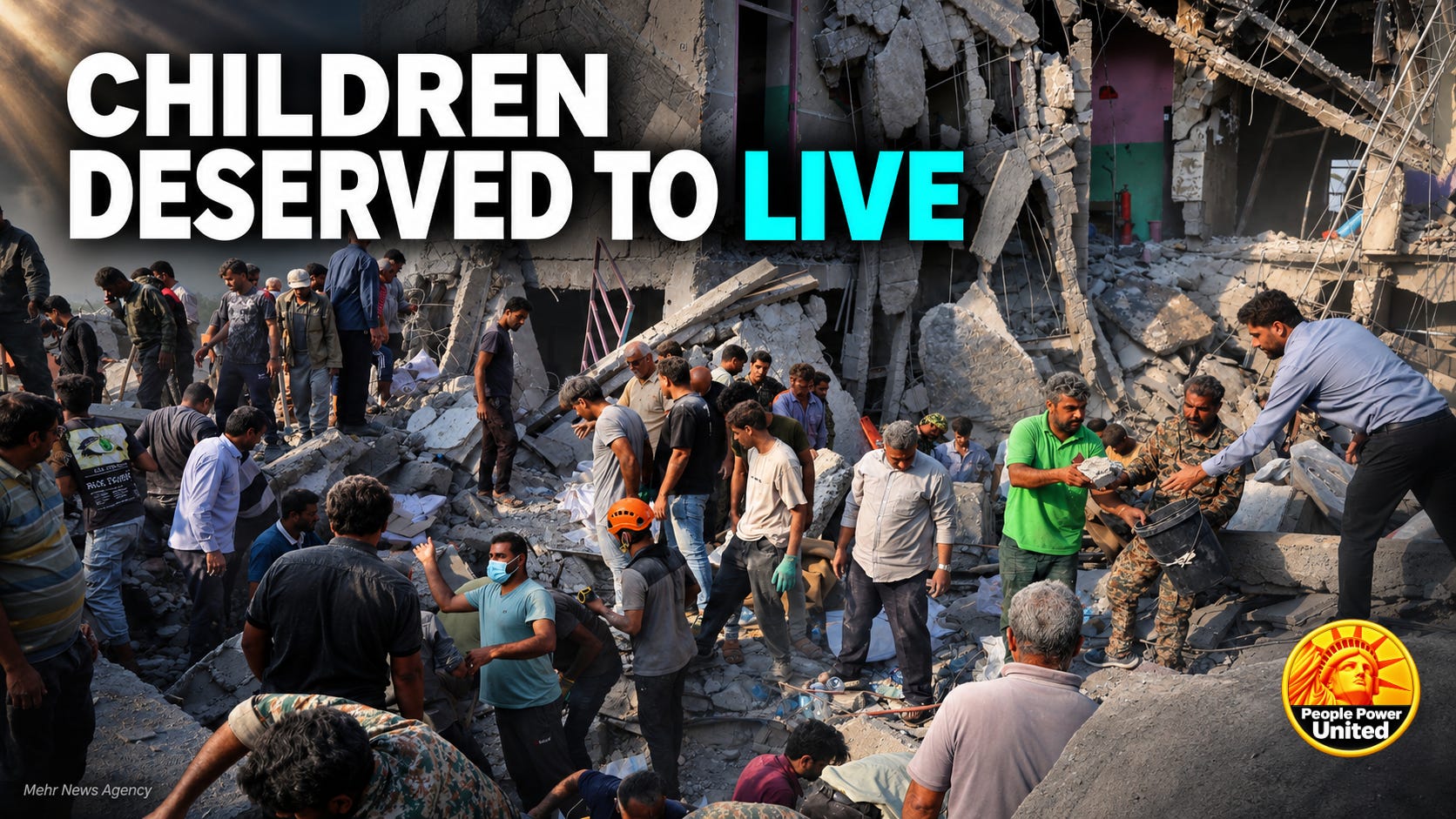
On the first day of the Iran war, a strike hit a girls’ school in Minab, Iran.
According to the impeachment resolution cited in the Congressional Record, more than 168 people were killed. 5
These figures have different scopes and require careful attribution, but the tragedy at the center of the reporting is unmistakable.
Children were killed.
Children who should have been sitting in classrooms, learning, laughing, complaining about homework, and making plans for their futures.
Instead, their families are grieving.
And what makes this story even more disturbing is what investigators uncovered about decisions made before the war.
According to ProPublica, Hegseth sought military commanders’ views about cutting the Pentagon’s civilian harm mitigation program. The commanders opposed the proposed reductions.
He proceeded with cuts anyway. 6
The reporting described Central Command’s dedicated civilian harm staff shrinking from 16 people to one.
One.
For an entire region facing major military operations.
Please think about that.
Imagine being responsible for preventing civilian deaths across a vast military theater and deciding that the people trained to help prevent those deaths were somehow expendable.
This is not just a debate about staffing charts or bureaucratic efficiency.
These programs exist because military decisions can have irreversible consequences for people who never chose to become part of a war.
The extent to which those reductions contributed to any particular strike requires investigation. We should not pretend the causal questions have already been resolved.
But when commanders warn against dismantling civilian safeguards, and those safeguards are cut anyway, Congress has every reason to demand answers.
Who made the final decision? What warnings were received? What alternatives were considered? What protections remained in place?
And most importantly, what will prevent another family from experiencing this kind of unimaginable loss?
Accountability cannot bring those children home.
But refusing accountability dishonors them all over again.

📱 The Signal Scandal: National Security Meets the Group Chat
Now, friends, allow me to introduce what might be one of the most absurd chapters in this entire mess.
The Secretary of Defense. Sensitive military operations. A personal phone. A commercial messaging app.
And a journalist accidentally included in the conversation.
Because apparently the Pentagon needed to explore whether national security could survive the organizational sophistication of a family vacation group chat.
I wish I were making that up.
In March 2025, Hegseth shared sensitive operational details concerning planned strikes in Yemen through Signal.
The Department of Defense Inspector General subsequently determined that his use of the messaging application violated department policy. 7
Let’s be precise.
The Inspector General identified a policy violation. That is not the same thing as a criminal conviction.
But it is still a serious finding involving one of the highest-ranking national security officials in the country.
The investigation also raised questions about disappearing messages, record preservation, and Hegseth’s decision not to participate in an interview with investigators.
And here’s what I find absolutely astonishing.
Ordinary service members are expected to follow strict procedures for handling sensitive information.
They cannot simply decide that the rules are inconvenient because they deem themselves as important people with important jobs.
Yet when the person sitting at the very top of the Pentagon becomes the subject of an Inspector General finding, we’re suddenly supposed to entertain a lengthy philosophical discussion about whether the rules really apply.
Excuse me?
National security is not a personal branding exercise.
And protecting the people carrying out military operations should not depend on whether their boss feels like following established communication procedures.
If the rules matter for the people serving under Hegseth, they should also matter for Hegseth.
Rank is not immunity. Authority is not accountability. And a fancy title does not magically transform a bad decision into responsible leadership.
🚤 The Boat Strikes: When Did Suspicion Become a Death Sentence?
Now we come to another deeply disturbing issue.
Since September 2025, American forces have conducted repeated lethal strikes against boats suspected of involvement in drug trafficking.
According to the reporting cited in the original draft, the campaign has involved dozens of attacks and hundreds of deaths. 8
The United States has not publicly established the identities and alleged conduct of every person killed or fully disclosed the intelligence supporting each strike.
And here’s the question that should concern every American, regardless of political affiliation.
Since when did being suspected of a crime automatically become grounds for a military death sentence?
We have laws. We have courts. We have evidence standards. We have due process.
Or at least we’re supposed to.
United Nations Special Rapporteur Ben Saul raised grave concerns about the strikes, including an assessment that the available evidence could support allegations of crimes against humanity. 9
That assessment is serious, but it is not a ruling by an international criminal court.
Impeachment filings have also raised allegations concerning attacks on survivors after initial strikes.
Those allegations require rigorous investigation and cannot responsibly be presented as adjudicated facts.
But let’s not lose sight of what is already known.
Human beings have been killed in military operations conducted under the banner of countering suspected drug trafficking.
And the public deserves to know the legal basis for those operations, the evidence supporting each use of lethal force, and what safeguards were in place to protect human life.
We cannot allow military force to replace evidence, due process, and the rule of law.
No uniform, office, or political slogan should place these decisions beyond scrutiny.
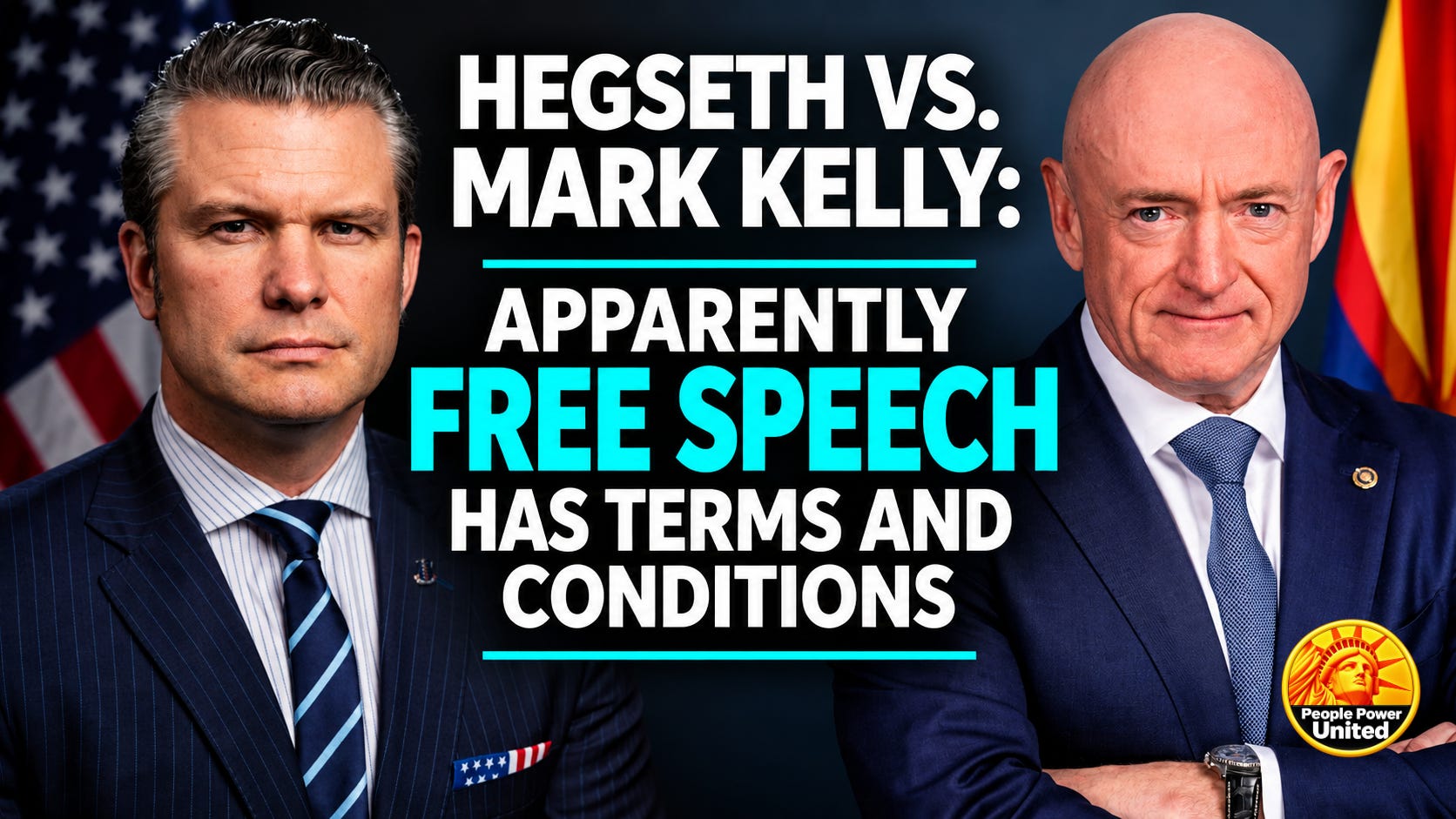
⚖️ Hegseth vs. Mark Kelly: Apparently Free Speech Has Terms and Conditions
And when you think this story cannot possibly become more absurd, along comes the controversy involving Senator Mark Kelly.
Kelly is a retired Navy combat veteran, former astronaut, and sitting United States senator.
He participated in a video reminding military personnel of their obligation not to follow unlawful orders.
That’s a fundamental principle of military law.
Hegseth responded by pursuing punitive action involving Kelly’s retired military status.10
A federal judge intervened.
On February 12, 2026, Judge Richard Leon issued a preliminary injunction blocking the action, finding serious First Amendment problems with the government’s position.11
And here’s where the hypocrisy practically writes its own punchline.
We hear endless speeches about patriotism, military service, constitutional freedom, and defending America.
But when a retired military officer serving in the United States Senate speaks about unlawful orders, suddenly his speech becomes a problem requiring punishment?
Apparently freedom of speech is wonderful, provided nobody uses it to criticize the people currently in charge.
How convenient.
And here’s another detail worth remembering.
President George W. Bush appointed Judge Leon.
This should not be reduced to a partisan popularity contest. The constitutional protections involved belong to all of us.
The injunction is a preliminary ruling, and any subsequent proceedings must be accurately reported. But the court’s intervention underscores why government retaliation against protected speech demands scrutiny.
Government power must have limits. Criticizing public officials is not a personal offense against the government.
And anyone occupying the Pentagon’s highest office should understand that distinction.
🔥 Impeachment Is Not Political Theater. It’s Constitutional Accountability.
Now, let’s talk about impeachment.
Because judging by the way some politicians discuss it, you might think impeachment is either a magic wand or a personal insult.
It is neither.
Impeachment is a constitutional accountability process.
The House may approve articles of impeachment. The Senate then conducts a trial, and conviction requires a two-thirds vote.12
That threshold is serious, as it should be.
Impeachment should never be treated casually. But it should not become impossible merely because powerful people dislike being questioned.
And what do we have before us?
We have congressional impeachment proposals.
We have a Defense Department Inspector General finding involving the mishandling of military information.
We have a federal court order having to blocking action against a sitting senator.
We have reporting about serious cuts to civilian harm protections and devastating civilian deaths.
And we have profound questions about military operations undertaken without new congressional authorization and lethal strikes whose legal justification demands scrutiny.
Those are not interchangeable findings. Each requires its own examination.
But together, they present an extraordinary list of actions that demand transparency.
So where are the complete records? Where are the sworn explanations? Where are the detailed public answers about civilian protections and the rules governing military force?
Congress has investigative tools for precisely these circumstances.
Subpoenas. Hearings. Document requests. Testimony under oath. Oversight.
You know, the actual work of governing.
And perhaps that is the part some powerful people find most inconvenient.
Because a press conference is easy.
A television appearance is easy.
Blaming your critics is practically a recreational activity in Washington.
But answering detailed questions under oath, producing records, and explaining decisions that may have cost lives?
That requires something far more demanding.
Accountability.

❤️ Friends, This Is Where We Come In
I know. It’s exhausting.
Another controversy. Another investigation. Another powerful official insisting everything is under control while the public is left asking questions that should have been answered months ago.
And sometimes it feels as though nothing changes, no matter how many stories emerge.
But I want you to remember something.
Congress does not belong to the politicians who occupy its offices. It belongs to the people.
The Constitution does not belong to the president.
The Pentagon does not belong to the Secretary of Defense.
And the public’s right to demand accountability does not expire because somebody in power finds those demands inconvenient.
We can insist that our representatives conduct meaningful oversight.
We can ask where they stand on proposed impeachment articles.
We can demand transparency about civilian deaths, military operations, and the use of public authority.
We can read the original records, question official explanations, and refuse to let serious allegations disappear beneath tomorrow’s headlines.
And we can keep showing up for one another.
Because this is bigger than Pete Hegseth.
It is about whether the United States will have enforceable limits on government power or whether those limits will exist only when politically convenient.
No president is above the law. No cabinet secretary is above accountability. And no military leader should be beyond meaningful civilian oversight.
The families who lost children deserve answers.
The people serving our country deserve responsible leadership.
And every American deserves a government that respects the rights and constitutional principles it has sworn to uphold.
Friends, powerful people may have the titles, the microphones, the military budgets, and the ability to hire entire teams of people to explain away their decisions.
But they do not own our democracy.
We do.
And we are not powerless.
Our voices matter. Our actions matter. And when ordinary people organize, speak out, and demand accountability together, we can change what happens next.
❤️ Enough Excuses. It’s Time for Accountability.
Friends, outrage alone won’t hold powerful people accountable. Our voices, our actions, and our determination can.
Pete Hegseth holds one of the most powerful positions in our government. That power comes with responsibility, and the American people have every right to demand answers.
Today’s call to action is simple: Speak out. Show up. Demand accountability.
✉️ TAKE ACTION: Send a Letter to Congress
Tell your representative to investigate Pete Hegseth’s leadership, demand transparency, and pursue meaningful accountability, including impeachment proceedings where the evidence warrants them.
✍️ ADD YOUR NAME: Sign the Petition
Join others demanding accountability for Hegseth’s decisions, civilian harm, and the use of military power. Make it clear that public office is a responsibility, not a shield from consequences.
📞 MAKE THE CALL: Hold Congress Accountable
Call the U.S. Capitol Switchboard at (202) 224-3121 and ask to be connected to your representative or senators.
Tell them:
“I’m your constituent, and I’m calling to demand meaningful congressional oversight of Defense Secretary Pete Hegseth. I want Congress to investigate his actions, demand sworn testimony and public answers, and pursue accountability, including impeachment if the evidence supports it.”
🔥 Remember Who Holds the Power.
The Pentagon belongs to the people. Congress answers to the people. And the Constitution protects the people, not just the powerful.
We are not powerless. We are the people they answer to.
Speak out. Show up. Refuse to let accountability become optional.
Laurie Woodward Garcia
(paid with hugs and kisses, not bought by special interests)
People Power United
The future is not lost. It is being built by us, together, right now.
❤️ Freedom over fascism. Progress over fear. Power to the people!
Massie impeachment resolution, Congressional Record, September 15, 2026: https://www.govinfo.gov/content/pkg/CREC-2026-09-15/pdf/CREC-2026-09-15-pt1-PgH5637-2.pdf
H.Res.935, introduced December 9, 2025: https://www.congress.gov/bill/119th-congress/house-resolution/935/text
Understanding the War Powers Resolution of 1973, Congressional Record, December 17, 2025: https://www.congress.gov/crs-product/IF13134
Defense News, November 4, 2026: U.S. military death toll reaches 23
H.Res.935, introduced December 9, 2025: https://www.congress.gov/bill/119th-congress/house-resolution/935/text
Investigative reporting on Hegseth's civilian harm program cuts and the Minab strike, August 25, 2026: https://www.propublica.org/article/hegseth-civilian-harm-mitigation-response-trump-defense-department
DoD Inspector General report, DODIG-2026-021, December 2, 2025: https://www.oversight.gov/sites/default/files/documents/reports/2025-12/DODIG_2026_021_Signal_Report_FINAL_Redacted%20SECURE.pdf
Ansari articles of impeachment, filed April 13, 2026: https://ansari.house.gov/imo/media/doc/repansarifilesarticlesofimpeachmentagainstsecretaryofwarpetehegseth.pdf
UN Special Rapporteur findings on U.S. boat strikes, September 21, 2026: https://www.theguardian.com/world/2026/sep/21/us-boat-strikes-crime-against-humanity
Hegseth announces censure and potential demotion of Sen. Mark Kelly, January 5, 2026, Washington Post: https://www.washingtonpost.com/national-security/2026/01/05/hegseth-mark-kelly-censure/
Judge Leon's preliminary injunction in Kelly v. Hegseth, February 12, 2026: https://www.theguardian.com/us-news/2026/feb/12/judge-hegseth-mark-kelly-military-rank
Impeachment in the United States, Wikipedia: https://en.wikipedia.org/wiki/Impeachment_in_the_United_States
Impeachment and conviction would make him ineligible for Federal office for life.
I am no fan of Hegseth, but.. . . . . To accuse him of starting a war without Congressional authorization seems to signal a remarkable lack of knowledge about history.
It seems forever that presidents (and Hegseth as part of rhe executive branch was acting for the president) have used the Constitutionally granted title of "commander in chief of the armed forces" to push America into wars. Is our collective memory so short that we have forgotten the early days of the wars in Korea and Vietnam?
The problem, I do believe, lies over and over again in the spineless abandonmenmt of Conggress to assert its power in this area. The vacuum so created is what has given presidents the dangerous proclivity for dragging America into wasteful and ill considered combat operations.
The fault lies, then, with a succession of Congresses which have failed to do the job conferred upon them by the Constitution.